B DAYS 5% dto - LIBROS DE BOLSILLO  Ver más

Enviar a
Provincia de Madrid
0
  • argentina
  • chile
  • colombia
  • españa
  • méxico
  • perú
  • estados unidos
  • internacional

Selecciona tu país

América

Europa

Resto del mundo

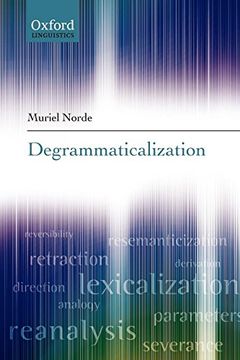
portada Degrammaticalization (Oxford Linguistics) (en Inglés)
Formato
Libro Físico
Año
2009
Idioma
Inglés
N° páginas
256
Encuadernación
Tapa Blanda
ISBN
0199207933
ISBN13
9780199207930
N° edición
1

Degrammaticalization (Oxford Linguistics) (en Inglés)

Muriel Norde (Autor) · Oxford University Press · Tapa Blanda

Degrammaticalization (Oxford Linguistics) (en Inglés) - Muriel Norde

Libro Nuevo Origen: España
Envío: 7 a 8 días háb.
71,84 €68,25 €
-5%
Libro Nuevo

Quedan 50 unidades

68,25 €
Llega entre el 09 Sep y el 15 Sep a Provincia de Madrid. Seleccionar ubicación

Reseña del libro "Degrammaticalization (Oxford Linguistics) (en Inglés)"

Grammaticalization is a well-attested process of linguistic change in which a lexical item becomes a function word, which may be further reduced to a clitic or affix. Proponents of the universality of grammaticalization have usually argued that it is unidirectional and have thus found it a useful tool in linguistic reconstruction. In this book Professor Norde shows that change is reversible on all levels: semantic, morphological, syntactic, and phonological. As a consequence, the alleged unidirectionality of grammaticalization is not a reliable reconstructional tool, even if degrammaticalization is a rare phenomenon.Degrammaticalization, she argues, is essentially different from grammaticalization: it usually comprises a single change, examples being shifts from affix to clitic, or from function word to lexical item. And where grammaticalization can be seen as a process, degrammaticalization is often the by-product of other changes. Nevertheless, she shows that it can be described, like grammaticalization, in a principled way, in order to establish whether a change in a word has been from more to less grammatical or vice versa, and the stages by which it has become so. Using data from different languages she constructs a typology of degrammaticalization changes. She explains why degrammaticalization is so rare and why some linguists have such strongly negative feelings about the possibility of its existence. She adds to the understanding of grammaticalization and makes a significant contribution to methods of linguistic reconstruction and the study of language change. She writes clearly, aiming to be understood by advanced undergraduate students as well as appealing to scholars and graduate researchers in historical linguistics.

Opiniones del libro

Preguntas frecuentes sobre el libro

Todos los libros de nuestro catálogo son Originales.
El libro está escrito en Inglés.
La encuadernación de esta edición es Tapa Blanda.

Preguntas y respuestas sobre el libro

¿Tienes una pregunta sobre el libro? Inicia sesión para poder agregar tu propia pregunta.

Opiniones sobre Buscalibre

Ver más opiniones de clientes