Compartir
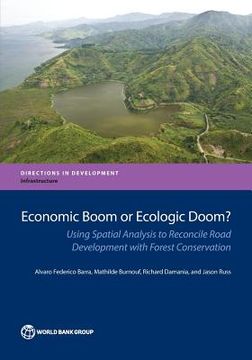
Economic Boom or Ecologic Doom?: Using Spatial Analysis to Reconcile Road Development with Forest Conservation (en Inglés)
Richard Damania
(Autor)
·
Alvaro Federico Barra
(Autor)
·
Mathilde Burnouf
(Autor)
·
World Bank Publications
· Tapa Blanda
Economic Boom or Ecologic Doom?: Using Spatial Analysis to Reconcile Road Development with Forest Conservation (en Inglés) - Barra, Alvaro Federico ; Burnouf, Mathilde ; Damania, Richard
Libro Nuevo
Importado
Envío: 16 a 21 días háb.
52,07 €49,47 €
Reseña del libro "Economic Boom or Ecologic Doom?: Using Spatial Analysis to Reconcile Road Development with Forest Conservation (en Inglés)"
The natural endowment of the Democrat Republic of Congo, in the form of land, minerals, and forests, is unparalleled. The right mix of policies has the potential to unleash incentives that could transform the economy. However, transport infrastructure in the DRC is amongst the sparsest and most dilapidated in the world, and this lack of infrastructure is likely a significant constraint to growth. This work considerably advances the information that is available to infrastructure planners, and provides methodologies that could be used to make more informed decisions to identify trade-offs between economic growth and environmental endangerment. The approach draws from the state-of the art across a variety of disciplines spatial (GIS) analysis, spatial econometrics, economic theory, and conservation biology to create an approach that can guide the location and level of investments by estimating benefits and environmental costs at a highly disaggregated spatial scale. The analysis proceeds in four related phases that combine economic assessments with geospatial analysis. First transport costs are estimated using GIS techniques. A variety of econometric procedures are then used to determine the economic effects of changing transport costs. Second, highly disaggregated spatial data is used to estimate the effects of roads on forest cover, and the resulting biodiversity that would be at risk from local deforestation. Next the two spatial estimates are combined to simulate the effects of different policies. Finally this provides a series of maps that identify regions where there are large trade-offs between economic and ecological goals. Overall the results suggests that the siting of infrastructure needs to consider impacts at the very outset of the planning process. This report presents both new data and new techniques that can be used to identify areas of opportunity, risk, and potential for REDD+ financing. Such upstream planning has been rendered both feasible and cost effective with the availability of geo-referenced information on forest cover and economic data. This report provides the data and easily comprehensible maps for such an exercise."